
West Chicago, Schaumburg IL
Garage Door Service for West Chicago Homes
Garage door repair and install for West Chicago, IL, 12 miles from our Schaumburg base. We know the 1980-era torsion setups common in this part of town.
Local detail
The Houses Here
West Chicago's housing stock centers on 1980, a fair bit newer than a lot of what we see closer to Schaumburg, where places can run back to 1938. That median year matters because 1980 is right in the window when builders had mostly switched from side-mounted hardware to torsion springs mounted straight above the door on a center shaft. If your house here went up in the late 70s or early 80s, you likely have a torsion spring setup with a steel raised-panel door, not the older extension-spring style with springs running along the horizontal tracks. That's good news for parts availability - torsion hardware from that era is still a known quantity, and we're not hunting down obsolete brackets the way we sometimes have to for pre-1960 builds elsewhere in the area.
It doesn't mean the doors are trouble-free. Forty-plus years on the same spring and the same rollers is enough time for fatigue to set in, and a lot of these openers have been replaced once already by a previous owner, sometimes with a unit that doesn't match the door's weight. We ask about install date and any past opener swaps before we quote anything, because a 1980 door with a 2015 opener behaves differently than one that's original top to bottom.
The area
What We Will Not Take On
We don't stock every obscure panel size, and if your door is a discontinued model with a bent or cracked panel, we'll tell you straight that replacement is the better call rather than trying to source a match that may not exist anymore. We also won't tell you a repair will hold if the door is at the end of its life - if the springs, hinges, and track are all showing wear at once, patching one part just moves the next failure a few months down the road. And we're not a same-day dispatch operation stationed in West Chicago itself; we run out of Schaumburg, roughly 12 miles off, so if you need someone standing at your door in the next twenty minutes, that's not us.
What we find
The Usual Work Here
With median income here at $100,568, most of the calls we get in this part of our coverage are planned repairs and replacements rather than emergency patch jobs - people budgeting for a new opener or a full door swap rather than paying for the cheapest possible fix. Across the wider area we cover, there are 525,414 households and 261,093 owner-occupied houses, and West Chicago's roughly 7,436 households are a smaller, more uniform slice of that - built in a tighter window than some of the older towns nearby.
That uniformity means we see the same handful of failure patterns repeat: torsion springs original to a 1980-ish install finally giving out after decades of cycles, worn rollers on steel tracks, and openers that were upgraded once but never had the travel limits reset properly for the door they're paired with. Cold-weather stiffening is part of it too - this area sits in a cold climate band, and grease that's thickened up in a January cold snap will make an aging spring work harder than it should, which speeds up the failure timeline on doors already near the end of their service life.
How we work
How That Shows Up in the Door
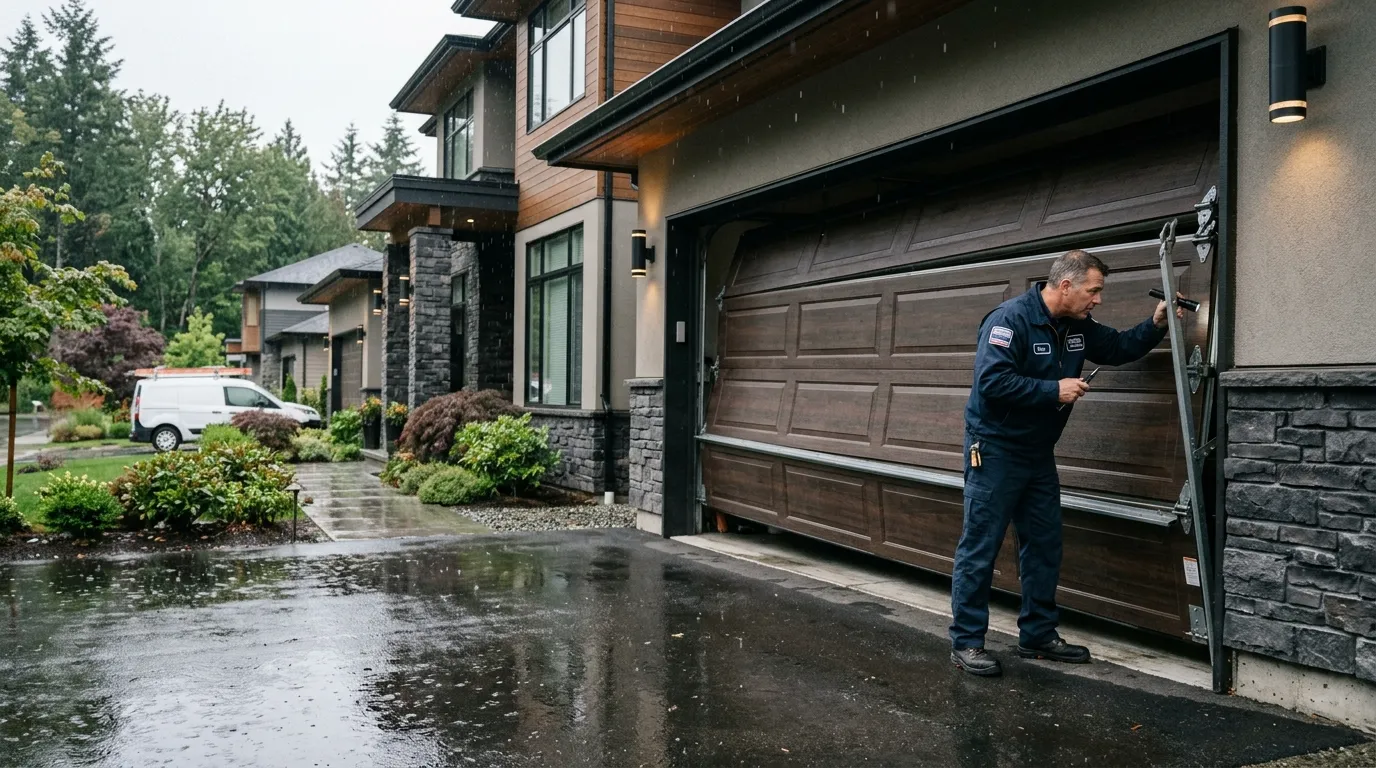
On a house built around 1980, the failure usually starts quiet: the opener strains a little longer before the door moves, or you notice the door doesn't sit flush at the bottom anymore. That's a torsion spring losing tension, not an opener problem, even though the opener is what's straining. Left alone, the cable can jump the drum or a bearing plate can wear through, and then you've got a door that won't move at all instead of one that's just slow.
Because most of these doors share the same era of hardware, the fix is usually straightforward once we're on site - matched torsion springs sized to the door's weight, fresh rollers if the old ones are chipped, and an opener force-and-limit check so it's not fighting the door on every cycle. We don't push replacement doors on people whose hardware is sound; a 1980-era door with a tuned-up torsion system can run another decade without issue.
Service areas
Other areas we cover near West Chicago
Questions
Common questions
How far out is Schaumburg Garage Door Pros from West Chicago?
We're based in Schaumburg, about 12 miles from West Chicago. We travel out for scheduled jobs; we're not a walk-in shop located in town, so plan on booking rather than expecting an immediate drop-in visit.
Are torsion springs standard on West Chicago garage doors?
For houses built around the area's median year of 1980, yes - torsion spring systems mounted above the door were standard by then. Older homes nearby, going back as far as 1938 in parts of our coverage area, are more likely to have the older extension-spring style along the tracks.
Is it worth repairing an old door instead of replacing it?
Depends on the hardware, not just the age. If the track and hinges are sound and only the spring or rollers have failed, repair usually makes sense. If several parts are worn at once, replacement often costs less over time than repeated fixes.
Ready when you are
Need a garage door sorted in Schaumburg?
Schaumburg Garage Door Pros repairs and installs garage doors, springs and openers in Schaumburg, IL and the surrounding area.