
Guide
What a Technician Checks First on a Schaumburg Garage Door
A Schaumburg technician's checklist: what gets inspected first on doors from the area's 1960s-70s housing stock, and why cold winters change the order.
Local detail
How Local Conditions Play In
Most of the housing in this part of the county went up between 1938 and 2009, with the bulk of it landing in the 1960s and 70s. That matters more than people think, because a door built for that era usually rides on steel tracks and torsion hardware sized to specs a lot of manufacturers stopped stocking a long time ago. Schaumburg sits in a cold, moderate climate band, so the first thing a technician thinks about before even lifting the door is temperature swing.
Grease in the spring coils and the roller bearings stiffens up in winter, which throws off the balance test you'd normally run first. A door that lifts easy in July can feel dead-weight heavy in January, and that's not always a bad spring - sometimes it's just cold grease pretending to be a bad spring. So the checks get reordered: balance and lift resistance first, spring wear second, because the cold changes what a normal reading even looks like on a given day.
The area
What to Look At First
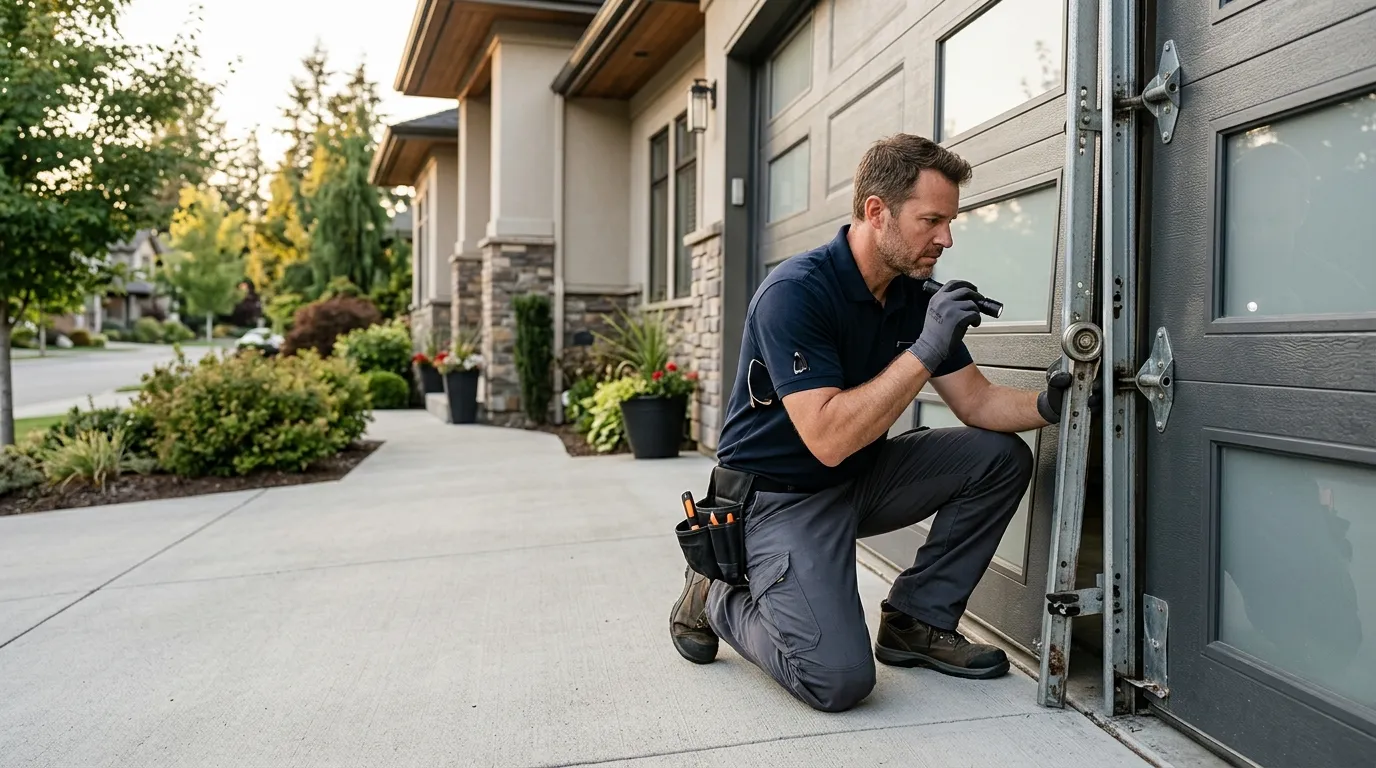
On a house from the 1960s-70s stock that makes up most of this area, the first physical check is the torsion spring and the winding cones - original hardware on a door that age has usually seen thousands of cycles, and the cones are where fatigue cracks start. Next is the cable, run end to end, looking for fraying near the drum, which shows up more on original single-spring setups than on newer double-spring doors. Then the track alignment - older track gauge doesn't always match what's sold today, so a tech checks whether a repair can use stock parts or needs an ordered piece.
Rollers get a look for flat spots, especially steel rollers original to a door this age. Last is the opener: gear-and-sprocket units from that build era wear a plastic gear that strips quietly over years, and by the time it fails outright the door has usually been chain-slapping for a while. None of this is guesswork - it's just checking things in the order they actually fail on doors this old, in this weather.
What we find
The Situation
This service area covers 92 named areas, and the housing pattern repeats across most of them - median household income here runs $112,168, and across the 525,414 households in the area, 261,093 are owner-occupied houses. That owner-occupied share is where the bulk of call volume comes from, because rental properties get doors replaced on a landlord's schedule, not a repair schedule. Roselle sits about three miles off, Hanover Park four, Streamwood and Itasca and Bloomingdale all within five - and the doors on that side share the same builder specs as the ones closer in, since they went up in the same construction wave.
Further out, toward South Barrington and Inverness at six miles, the stock skews a little newer, which changes what a first check turns up. It's not one town's worth of houses behaving the same way - it's a wide band of similar-era construction, and a technician who's worked this area learns to expect the same handful of failure points before the panel's even off the hinge.
How we work
What It Costs
We don't have a flat number to hand out here, because cost on a door this age depends on whether the part needed is still a stock item or has to be ordered - original hardware from the 1938-2009 build window isn't all still on the shelf. A stripped opener gear or a frayed cable on a common size is usually a same-visit fix. A discontinued panel profile, or track gauge that doesn't match current stock, takes longer and costs more because it has to be sourced rather than pulled off the truck.
That's the honest limit here: if your door needs a part that's genuinely out of production, we're not going to force a mismatched piece onto it just to close the job fast, and that means a wait you wouldn't have with a newer door. It's worth knowing going in, especially if the door hasn't been touched since it was installed.
Questions
Common questions
Why does my garage door feel harder to lift in winter?
Cold thickens the grease in the torsion spring coils and roller bearings, which increases resistance even when the spring itself is fine. Schaumburg's cold, moderate climate band means this shows up seasonally. A technician checks lift resistance before assuming a spring is failing, because a cold-stiff door and a worn-out spring can feel similar at first push.
Is my door's hardware still available if it breaks?
Depends on the age. Housing here was mostly built in the 1960s and 70s, and some track gauges and panel profiles from that window aren't stock items anymore. If a part is discontinued, we order it in rather than fit something that doesn't match, which can add time to the job.
Does an older door in this area usually need full replacement or just repair?
It depends on what's worn. Cable fray, stripped opener gears, and cone fatigue on original torsion springs are all repairable on their own. Full replacement tends to make more sense once several of those are failing at once on a door that's original to a 1960s-70s build.
Ready when you are
Need a garage door sorted in Schaumburg?
Schaumburg Garage Door Pros repairs and installs garage doors, springs and openers in Schaumburg, IL and the surrounding area.